
12-Hour and 24-Hour Clock: Conversion Table, Rules and the Midnight Trap on Train Tickets
A full conversion table, the two hours that cause most mistakes, how to read 00:15 on an IRCTC ticket without missing your train, and worked examples for overnight journeys and time zones.
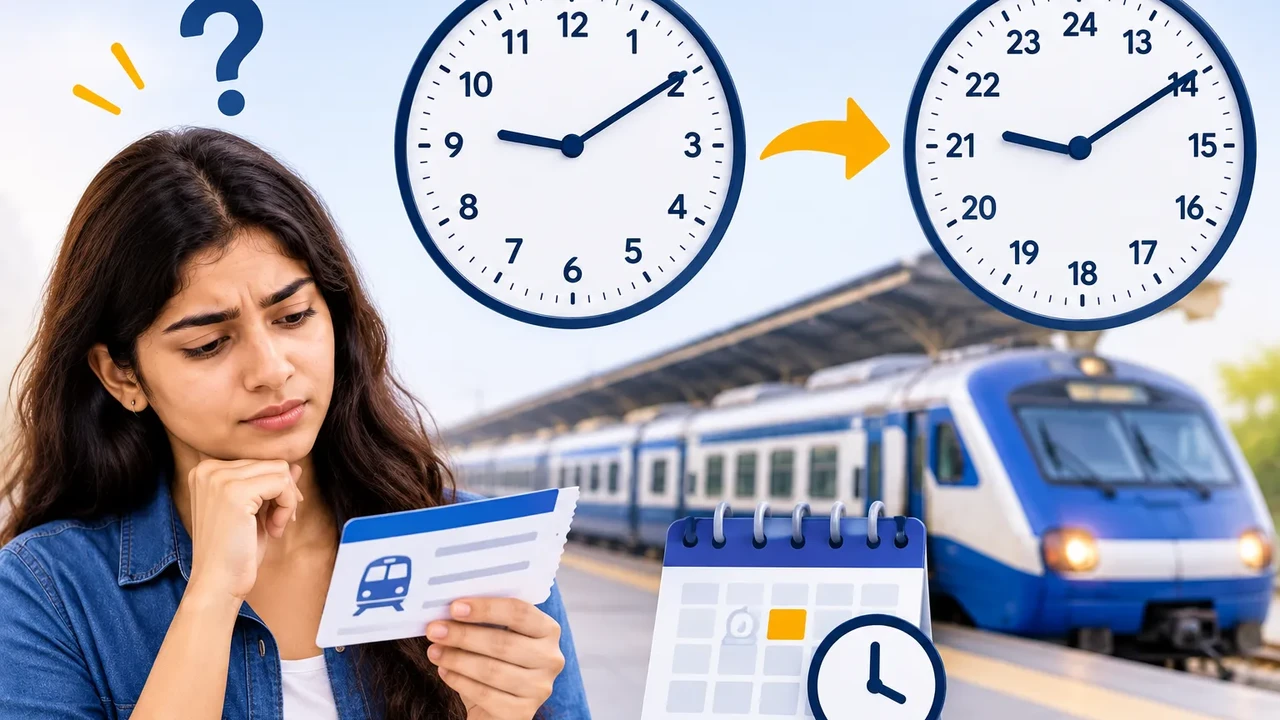
Quick answer: The 12-hour clock counts the day in two rounds of 12 hours and adds a.m. (midnight to noon) or p.m. (noon to midnight). The 24-hour clock counts straight from 00:00 at midnight to 23:59 one minute before the next midnight, with no a.m. or p.m. To convert a p.m. time to 24-hour time, add 12 to the hour (4:30 p.m. = 16:30). To go back, subtract 12 from any hour above 12 (19:05 = 7:05 p.m.).
There are only two exceptions to learn: the hour after midnight is written 00 in 24-hour time (12:20 a.m. = 00:20), and the hour after noon stays 12 (12:20 p.m. = 12:20). Almost every mistake people make with these clocks, on train tickets and in exams, comes from those two hours.
How the two clocks count the day
A day has 24 hours either way. The two systems only label them differently.
12-hour clock: 12 a.m. (midnight), 1 a.m., 2 a.m. … 11 a.m., then 12 p.m. (noon), 1 p.m. … 11 p.m. The numbers repeat, so you need a.m. or p.m. to know which half of the day you mean.
24-hour clock: 00:00, 01:00 … 12:00 (noon) … 23:00, 23:59. Every hour has its own number, so there's nothing to add. It is usually written with four digits and a colon (07:45, 18:30). In defence use you'll also see it without the colon, as in "0745 hours".
Also read: Trigonometry Table: Standard Values You Need to Know by Heart
12-hour to 24-hour conversion table
12-hour time | 24-hour time | 12-hour time | 24-hour time | |
12:00 a.m. (midnight) | 00:00 | 12:00 p.m. (noon) | 12:00 | |
1:00 a.m. | 01:00 | 1:00 p.m. | 13:00 | |
2:00 a.m. | 02:00 | 2:00 p.m. | 14:00 | |
3:00 a.m. | 03:00 | 3:00 p.m. | 15:00 | |
4:00 a.m. | 04:00 | 4:00 p.m. | 16:00 | |
5:00 a.m. | 05:00 | 5:00 p.m. | 17:00 | |
6:00 a.m. | 06:00 | 6:00 p.m. | 18:00 | |
7:00 a.m. | 07:00 | 7:00 p.m. | 19:00 | |
8:00 a.m. | 08:00 | 8:00 p.m. | 20:00 | |
9:00 a.m. | 09:00 | 9:00 p.m. | 21:00 | |
10:00 a.m. | 10:00 | 10:00 p.m. | 22:00 | |
11:00 a.m. | 11:00 | 11:00 p.m. | 23:00 |
The minutes never change. Only the hour does.
How to convert, step by step
From 12-hour to 24-hour time
a.m. time, 1 to 11: keep the hour and add a leading zero if it's a single digit. 6:10 a.m. → 06:10.
12 a.m. (the midnight hour): change 12 to 00. 12:45 a.m. → 00:45.
12 p.m. (the noon hour): keep 12. 12:45 p.m. → 12:45.
p.m. time, 1 to 11: add 12 to the hour. 9:45 p.m. → 9 + 12 = 21 → 21:45.
From 24-hour to 12-hour time
00:xx: change 00 to 12 and add a.m. 00:40 → 12:40 a.m.
01:xx to 11:xx: drop the leading zero and add a.m. 08:05 → 8:05 a.m.
12:xx: keep 12 and add p.m. 12:30 → 12:30 p.m.
13:xx to 23:xx: subtract 12 and add p.m. 17:50 → 17 − 12 = 5 → 5:50 p.m.
A quick check: if the 24-hour hour is 13 or more, the answer must be p.m.; if it is 00 to 11, it must be a.m.
Where you'll actually see 24-hour time in India
Most Indians speak in 12-hour time ("saat baje", "quarter past nine"), but several things you rely on are printed in 24-hour time:
Train timetables and tickets. Indian Railways timetables, the NTES running-status app and IRCTC tickets show departure and arrival in 24-hour format, such as 23:55 or 05:10.
Flight tickets and airport boards. Airlines and airports use the 24-hour clock for every scheduled time.
Exams. Time-conversion and duration questions come up in school maths and in the reasoning sections of competitive and government exams.
All of these use Indian Standard Time (IST), which is 5 hours 30 minutes ahead of Coordinated Universal Time (UTC+5:30). It is based on the 82.5° E line of longitude, and India's official time is kept by the CSIR-National Physical Laboratory in New Delhi.
The midnight trap on train tickets
This is the mistake that makes people miss trains. Suppose your ticket says:
Departure: 00:15, date 12 December
00:15 is fifteen minutes after midnight. So the train leaves 15 minutes into 12 December, which in everyday speech is "late on the night of the 11th". If you turn up on the evening of the 12th, the train left almost a day earlier.
The safe habit: when a departure time starts with 00, plan to be at the station the night before the printed date. Go by the date and time printed for your own boarding station; the ticket's journey or start date can refer to the train's origin station.
The same logic applies to arrival. A train shown as arriving at 00:30 on a Wednesday gets in 30 minutes after Tuesday night ends, so tell the person picking you up "Tuesday night, just after midnight", not "Wednesday night".
12 a.m. or 12 p.m.? Why many people avoid both
By the usual convention, 12 a.m. is midnight and 12 p.m. is noon. But the US National Institute of Standards and Technology (NIST) says in its times-of-day FAQ that "12 a.m. and 12 p.m. are ambiguous and should not be used". Write noon or midnight instead. For deadlines, NIST suggests 11:59 p.m. or 12:01 a.m. on a stated date, so no one can argue about which day midnight belongs to.
In 24-hour time this problem disappears: noon is 12:00 and midnight is 00:00. You may occasionally see 24:00 used for the end of a day, so "31 March 24:00" and "1 April 00:00" are the same moment, but most tickets and timetables stick to 00:00 or 23:59.
Also read: Can I Give an Olympiad Exam After 12th? Eligibility Rules for 2026-27
Worked examples: durations and time differences
Durations are where the 24-hour clock is easier, because you never have to switch between a.m. and p.m.
Example 1: A flight on the same day
A flight leaves Delhi at 14:35 and lands in Bengaluru at 17:10. How long is it?
From 14:35 to 17:35 is 3 hours, but it lands 25 minutes earlier.
3 h − 25 min = 2 hours 35 minutes.
Example 2: An overnight train
A train leaves at 22:50 and arrives at 06:15 the next morning.
22:50 to midnight (24:00) = 1 hour 10 minutes
Midnight to 06:15 = 6 hours 15 minutes
Total = 7 hours 25 minutes
Splitting at midnight is the simplest method for any journey that runs overnight.
Example 3: A two-night journey
A long-distance train leaves at 18:40 on Day 1 and arrives at 11:05 on Day 3.
18:40 on Day 1 to 18:40 on Day 2 = 24 hours
18:40 on Day 2 to 11:05 on Day 3: 18:40 to 24:00 = 5 h 20 min, then 00:00 to 11:05 = 11 h 5 min, so 16 h 25 min
Total = 24 h + 16 h 25 min = 40 hours 25 minutes
Example 4: Adding time across midnight
A movie marathon starts at 23:30 and lasts 3 hours 45 minutes. When does it end?
23:30 + 30 min = 00:00
3 h 15 min left, so 00:00 + 3 h 15 min = 03:15 (3:15 a.m. the next day)
Example 5: A different time zone
Thailand is 1 hour 30 minutes ahead of India. If a hotel in Bangkok says check-out is at 10:00, what time is that in India?
10:00 − 1 h 30 min = 08:30 IST
Common mistakes to avoid
Writing 12 p.m. as 24:00 or 00:00. Noon is 12:00. Only midnight is 00:00.
Writing 12:30 a.m. as 12:30. It is 00:30. 12:30 on its own means half past noon.
Adding 12 to a.m. times. 9 a.m. is 09:00, not 21:00. You add 12 only for p.m. hours from 1 to 11.
Writing 13:00 p.m. A 24-hour time never takes a.m. or p.m.
Subtracting across midnight without splitting. 06:15 − 22:50 gives a negative number. Split at midnight as in Example 2, or add 24 hours to the later time first.
Frequently asked questions
Is 00:00 midnight or noon?
00:00 is midnight, the start of a new day. Noon is 12:00 in 24-hour time.
How do you say 24-hour time out loud?
Say the hours and minutes as numbers: 18:30 is "eighteen thirty", and 07:05 is "oh-seven-oh-five" or "seven oh five". In defence use, a whole hour is said as "hundred hours", so 14:00 is "fourteen hundred hours".
Why is the 24-hour clock called military time?
Armed forces, including India's, use it because each time can only mean one moment, which matters when orders must be exact. They often write it without a colon and say "hours", as in 1830 hours.
What do a.m. and p.m. stand for?
They come from Latin: a.m. is ante meridiem (before midday) and p.m. is post meridiem (after midday). That is why the 12-hour clock restarts at noon.
Filed under Education



Comments