
Area of a Trapezium: Formula, Derivation and Worked Examples (NCERT Class 8 and 9)
Six solved problems take you from the basic formula to a field with only four sides given, plus a plot measured in gaj, the trapezium vs trapezoid naming and the new NCERT chapters where it appears.
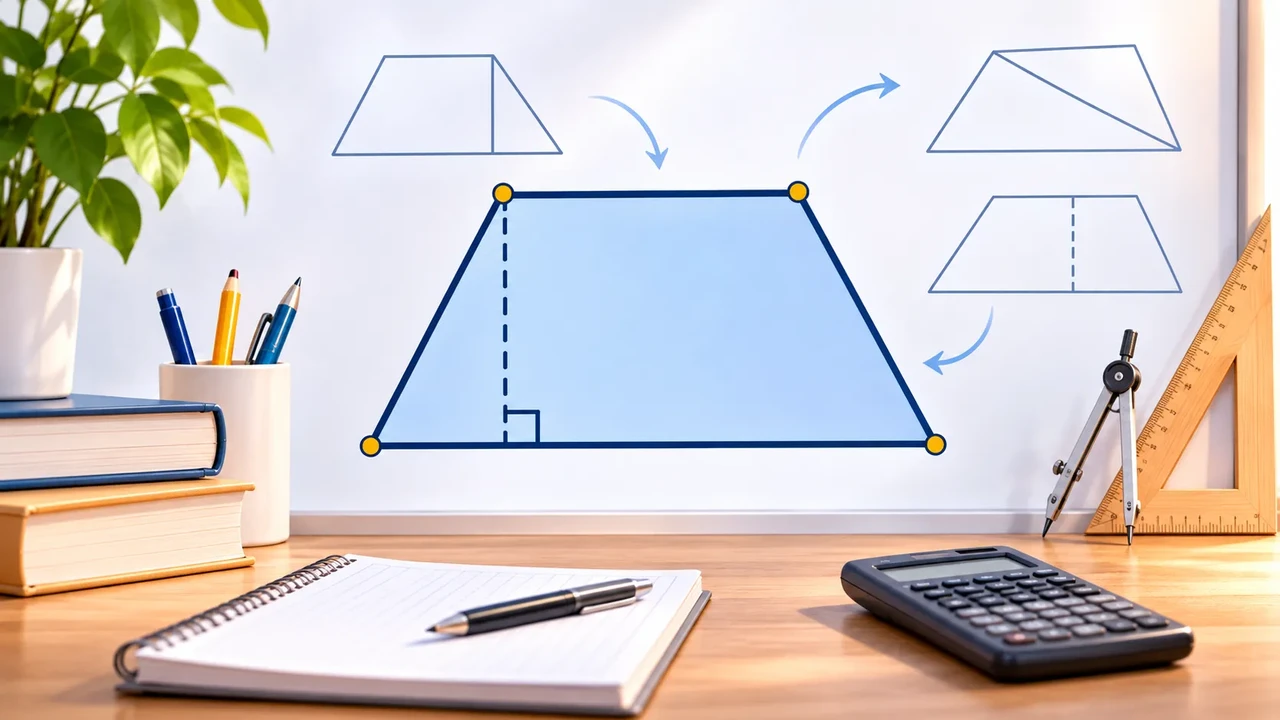
Quick answer: The area of a trapezium is half the sum of its two parallel sides multiplied by the perpendicular distance between them. In symbols: Area = ½ × (a + b) × h, where a and b are the parallel sides and h is the height. If the parallel sides are 12 cm and 8 cm and the height is 5 cm, the area is ½ × 20 × 5 = 50 cm².
Put simply: average the two parallel sides, then multiply by the height. Finding a missing side, working without the height and measuring a plot in gaj all come from this one formula.
What is a trapezium?
A trapezium is a quadrilateral with exactly one pair of parallel sides. The parallel sides are often called the bases. The other two sides are the legs, or non-parallel sides. The height is the perpendicular distance between the bases. It is not the length of a slanting side.
Special cases:
Isosceles trapezium: the two non-parallel sides are equal, so the shape is symmetric.
Right trapezium: one leg is perpendicular to the bases, so that leg is the height.
Trapezium or trapezoid?
The same shape goes by different names in different countries. Indian textbooks (NCERT and state boards) and British books call it a trapezium. In the USA and Canada it is a trapezoid. (Confusingly, American dictionaries such as Merriam-Webster still use "trapezium" for a quadrilateral with no parallel sides.) An American "area of a trapezoid" page uses the same formula. For CBSE and state board exams, write "trapezium".
Also read: Volume of a Sphere: Formula, Derivation, Worked Examples and Common Mistakes
Where it appears in the NCERT syllabus
NCERT is bringing in new textbooks under NCF-SE 2023, so older chapter numbers online may be out of date:
Class | Current NCERT book | Chapter | What you learn |
8 | Ganita Prakash, Part II | Chapter 7: Area | Area of a trapezium and other polygons |
9 | Ganita Manjari, Part I (2026–27) | Chapter 6: Measuring Space: Perimeter and Area | Heron's formula for the area of a triangle from its three sides |
In the older books this topic was in Class 8 "Mensuration" and Class 9 "Heron's Formula". Your school's syllabus may differ, so check the textbook your school uses. You can download the current books free from NCERT's textbook page.
Why the formula works: two triangles
Take trapezium ABCD with AB ∥ DC, AB = a, DC = b and height h. Draw the diagonal AC. It cuts the trapezium into two triangles:
Triangle ABC has base AB = a. Its height is the distance from C to line AB, which is h. Area = ½ × a × h.
Triangle ACD has base DC = b. Its height is the distance from A to line DC, which is also h. Area = ½ × b × h.
Add the two areas:
Area = ½ × a × h + ½ × b × h = ½ × (a + b) × h
Both triangles share the height h because the bases are parallel. You can find a triangle's area in other ways too, for example from two sides and the angle between them, and these are useful when a trapezium problem gives angles instead of the height.
Worked examples
Example 1: All three values given
Parallel sides 12 cm and 8 cm, height 5 cm.
Area = ½ × (12 + 8) × 5 = ½ × 20 × 5 = 50 cm²
Example 2: Finding a missing parallel side
A trapezium has area 180 m², height 12 m and one parallel side 18 m. Find the other parallel side.
Rearrange: a + b = 2 × Area ÷ h = 2 × 180 ÷ 12 = 30. So b = 30 − 18 = 12 m.
Example 3: Finding the height
Area 91 cm², parallel sides 9 cm and 17 cm.
h = 2 × Area ÷ (a + b) = 182 ÷ 26 = 7 cm
Example 4: Isosceles trapezium with slanting sides given
Parallel sides 16 cm and 10 cm, each non-parallel side 5 cm. The height is not given.
The longer base sticks out by (16 − 10) ÷ 2 = 3 cm on each side. Each slanting side is the hypotenuse of a right triangle with base 3 cm, so h = √(5² − 3²) = √16 = 4 cm.
Area = ½ × (16 + 10) × 4 = 52 cm²
When you only know the four sides
Class 9 field problems often give all four sides but no height. Split the shape instead.
Example 5: A field is a trapezium with parallel sides 25 m and 10 m and non-parallel sides 14 m and 13 m. Find its area.
From one end of the shorter side (10 m), draw a line parallel to one leg, down to the longer side. This cuts off a parallelogram with sides 10 m and 13 m and leaves a triangle.
The triangle's sides are 14 m, 13 m and 25 − 10 = 15 m.
Heron's formula: s = (15 + 14 + 13) ÷ 2 = 21. Area = √(21 × 6 × 7 × 8) = √7056 = 84 m².
The triangle's height on the 15 m side is the trapezium's height: h = 2 × 84 ÷ 15 = 11.2 m.
Trapezium area = ½ × (25 + 10) × 11.2 = 196 m²
Check: parallelogram (10 × 11.2 = 112 m²) + triangle (84 m²) = 196 m², which matches.
Units, and measuring a plot in India
Area is always in square units. If the lengths are in cm, the area is in cm². If they are in m, it is in m². Use the same unit for all the lengths before you multiply.
A plot on a bending road or a field along a canal is often roughly a trapezium. In much of north India, residential plots are sold in gaj. One gaj is one square yard, which is 9 square feet or about 0.836 m².
Example 6: A plot has a 40 ft front, a 30 ft back (the two parallel sides) and a depth of 60 ft measured at right angles between them.
Area = ½ × (40 + 30) × 60 = 2,100 sq ft
In gaj: 2,100 ÷ 9 ≈ 233.3 gaj
In m²: 2,100 × 0.0929 ≈ 195.1 m²
Measure the depth straight across, at right angles to the front and back. Do not measure along a side boundary that slants. The formula needs the perpendicular distance, so a slanting measurement gives too large an area. Official land records use their own surveys, so treat this as a rough check.
Also read: Surface Area of a Cylinder: Formula, Worked Examples and Practice Questions
Formulas at a glance
You want | Formula |
Area | ½ × (a + b) × h |
Height | h = 2 × Area ÷ (a + b) |
Missing parallel side | b = (2 × Area ÷ h) − a |
Height of an isosceles trapezium (leg c) | h = √(c² − ((a − b) ÷ 2)²) |
Common mistakes
Using a slanting side as the height. The height is always perpendicular to the parallel sides.
Adding the wrong pair. Add only the two parallel sides, never a parallel side and a leg.
Forgetting the ½. (a + b) × h is the area of the doubled parallelogram, not of the trapezium.
Mixing units. With sides 1.2 m and 80 cm and height 50 cm, convert to 120, 80 and 50 cm first: ½ × 200 × 50 = 5,000 cm², or 0.5 m².
Wrong units in the answer. Area is in cm² or m², not cm or m.
Frequently asked questions
What is the formula for the area of a trapezium?
Area = ½ × (sum of the parallel sides) × (perpendicular height), or ½ × (a + b) × h. The answer is in square units such as cm² or m².
How do you find the area of a trapezium without the height?
If you know all four sides, split the trapezium into a parallelogram and a triangle. Find the triangle's area with Heron's formula, use it to get the height, and then apply ½ × (a + b) × h. For an isosceles trapezium you can find the height with Pythagoras' theorem.
Is a trapezium the same as a trapezoid?
Yes, in the usual school sense. India and the UK say trapezium for a quadrilateral with one pair of parallel sides, and the USA calls the same shape a trapezoid. The area formula is identical.
Which NCERT chapter teaches the area of a trapezium?
In the new NCERT books it is in Class 8 Ganita Prakash Part II, Chapter 7 (Area). Heron's formula, which you need when only the sides are known, is in Class 9 Ganita Manjari Part I, Chapter 6 (Measuring Space: Perimeter and Area). Older editions put it in "Mensuration" and "Heron's Formula".
Filed under Education
Read next




Comments