
Borderline Personality Disorder: Symptoms, Causes, BPD vs Bipolar and Getting Help in India
The four symptom areas of BPD, what raises the risk, a side-by-side table with bipolar disorder, why therapies like DBT work, and how to get assessed in India through a psychiatrist, psychologist or Tele-MANAS.

Quick answer: Borderline personality disorder (BPD) is a long-standing pattern of intense, fast-changing emotions, an unstable sense of self, stormy relationships and impulsive behaviour. Its exact cause is unknown, but experts point to a mix of genes, brain differences and painful early experiences such as trauma or neglect.
The most important thing to know: BPD is treatable. According to the NHS, many people with BPD see their symptoms improve over time, and specialised talking therapies such as dialectical behaviour therapy (DBT) are the main treatment. In India, a psychiatrist or an RCI-registered clinical psychologist can assess you, and the free Tele-MANAS helpline (14416) can tell you where to start.
Symptoms of borderline personality disorder
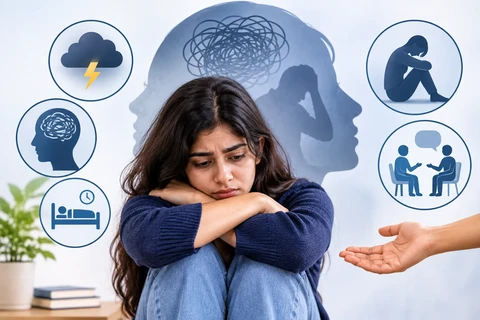
BPD is not "being dramatic" or a weak character. People with BPD feel emotions very intensely, and those emotions take longer to settle. The NHS groups the symptoms into four areas.
Emotions that swing fast and hard
Intense anger, fear, guilt or grief that feels overwhelming
Mood that changes sharply within hours, often after something happens with another person
A long-lasting sense of emptiness or loneliness
Unstable relationships
A strong fear of being abandoned, real or imagined, and frantic efforts to keep people close
Seeing the same person as wonderful one day and an enemy the next, which the NHS calls "black-white" thinking
Relationships that are intense, short and painful
Impulsive behaviour
Acting on urges when upset: overspending, binge eating, heavy drinking or drug use, reckless driving, unsafe sex
Urges to hurt oneself
Thinking and sense of self
Not knowing who you really are, with goals and self-image shifting often
Feeling worthless or "unreal"
Under extreme stress, brief spells of feeling detached from yourself (dissociation) or paranoid thoughts
According to the US National Institute of Mental Health (NIMH), BPD is usually diagnosed in late adolescence or early adulthood, and symptoms vary a lot from person to person.
A gentle note on safety
Self-harm and suicidal thoughts can be part of BPD; NIMH says people with BPD have a much higher rate of both than the general population. These feelings are a sign of real pain, not "attention-seeking". If you or someone you know is in crisis, call Tele-MANAS on 14416 (free, 24x7) or the emergency number 112 right away.
Also read: Autism Spectrum Disorder: Symptoms, Causes and Getting Assessed in India
How BPD is diagnosed
Only a qualified mental health professional can diagnose BPD, after a detailed conversation about your symptoms and personal and family history; a medical check-up may rule out other causes. An online quiz cannot tell you whether you have it. Two manuals are used worldwide:
Manual | How it describes BPD |
DSM-5 (American Psychiatric Association) | A separate diagnosis: at least 5 of 9 listed features, as a lasting pattern that began by early adulthood and shows up across many areas of life |
ICD-11 (World Health Organization) | One "personality disorder" diagnosis graded mild, moderate or severe, with an optional "borderline pattern" specifier (code 6D11.5) when instability and impulsivity are prominent |
Both cover the same symptoms listed above. You may also hear the name "emotionally unstable personality disorder" (EUPD), which the UK charity Mind notes is another term for BPD.
What causes BPD?
The exact cause is unknown. The National Institute of Mental Health says genetic, environmental and social factors may all raise the risk:
Family history: having a close relative with BPD may increase the risk.
Brain differences: studies find differences in areas that manage emotions and impulses, though NIMH says it is unclear whether these are a cause or a result.
Difficult early experiences: the NHS says most people with BPD have experienced some form of trauma or neglect as children. Many report abuse, abandonment or unstable, invalidating relationships.
Risk factors are not destiny. NIMH stresses that having them does not mean a person will develop BPD, and some people develop it without any of them.
BPD vs bipolar disorder
Both involve mood changes and impulsivity, so they are often confused. They are different conditions with different treatments, and a person can have both. (For the bipolar side in detail, see our guide to bipolar disorder symptoms and causes.)
Borderline personality disorder | Bipolar disorder | |
Type of condition | Personality disorder: a long-term pattern of feeling, thinking and relating | Mood disorder: distinct episodes of mania/hypomania and depression |
How long mood shifts last | Usually hours, rarely more than a few days | Manic episodes last days to weeks; depressive episodes weeks to months |
What sets them off | Usually events, especially conflict or perceived rejection | Less linked to events; stress and disrupted sleep can trigger episodes |
Between shifts | Emotional ups and downs are part of everyday life | Mood is often fairly stable between episodes |
Impulsive behaviour | Short bursts during intense distress | Lasts day after day during an episode |
Main treatment | Specialised talking therapy (DBT, MBT) | Mood-stabilising medicines, supported by therapy |
Sources: NIMH, Cleveland Clinic and NewYork-Presbyterian Hospital. As NIMH puts it, BPD symptoms occur without the clearly raised mood seen in mania or hypomania.
BPD also often overlaps with depression, anxiety, eating disorders, substance use and post-traumatic stress, according to NIMH. If trauma is a big part of the picture, our explainer on PTSD symptoms and causes may help.
Is BPD treatable?
Yes. The NHS says many people overcome their symptoms over time, though some need more help if symptoms return. Talking therapy is the main treatment:
Dialectical behaviour therapy (DBT): developed specifically for BPD. It teaches skills to manage intense emotions, ride out distress without acting on harmful urges, and handle relationships, usually through weekly individual and group sessions. NICE, the UK health guidance body, says: "For women with borderline personality disorder for whom reducing recurrent self-harm is a priority, consider a comprehensive dialectical behaviour therapy programme."
Mentalisation-based therapy (MBT): helps you understand your own and other people's thoughts and feelings, especially during conflict. The NHS says it usually runs for about 18 months.
Other approaches: NIMH says cognitive behavioural therapy can help, and family therapy is often useful.
According to the NHS guide to BPD treatment, therapy may last a year or longer. NICE says "drug treatment should not be used specifically for borderline personality disorder or for the individual symptoms or behaviour associated with the disorder", and the NHS says no medicine is currently licensed to treat BPD, though a psychiatrist may treat a co-existing problem such as depression. Decisions about medicines belong with your own doctor.
Also read: Bipolar Disorder Symptoms and Causes: Mania vs Hypomania, Types and Indian Data
Getting assessed for BPD in India
See a psychiatrist or a clinical psychologist. A psychiatrist is a medical doctor who can diagnose and prescribe. A clinical psychologist assesses and provides therapy; clinical psychologists are registered in the Rehabilitation Council of India's Central Rehabilitation Register, so ask for their RCI registration.
Use government services if cost is a worry. Government medical college hospitals have psychiatry outpatient clinics. Under Section 18 of the Mental Healthcare Act, 2017, every person has a right to access mental healthcare from government-run or government-funded services, free for people who are homeless, destitute or below the poverty line.
Call Tele-MANAS if you don't know where to begin. The Health Ministry's helpline, 14416 or 1800-891-4416, is free, works 24x7 and offers counselling in about 20 Indian languages, with referral to services nearby.
Ask about DBT. Not every therapist offers it, so ask whether they are trained in DBT or another BPD-focused therapy.
See a professional if emotions or relationships regularly feel out of control, if impulsive behaviour is causing harm, or if you think about hurting yourself.
Stigma: what BPD is not
BPD carries heavy stigma, and Mind notes that some people find the label itself stigmatising. A few myths worth dropping:
"They're manipulative." Frantic efforts to avoid abandonment come from fear and pain, not scheming.
"It's untreatable." The NHS and NIMH both say evidence-based therapies help many people.
"It's the same as narcissism." It isn't; our article on narcissistic personality disorder explains that condition.
If someone you love has BPD, encourage them to get assessed and stick with treatment. Families can call Tele-MANAS for support too.
Frequently asked questions
Can borderline personality disorder be cured?
There is no instant cure, but BPD is very treatable. According to the NHS, many people overcome their symptoms over time with specialised talking therapy, though some need further help later.
Is BPD the same as bipolar disorder?
No. BPD mood shifts usually last hours and follow events, especially in relationships, while bipolar disorder involves distinct episodes of mania and depression lasting days to months. They are treated differently, and a person can have both.
At what age does BPD start?
NIMH says it is usually diagnosed in late adolescence or early adulthood. Under-18s are usually diagnosed only when symptoms are severe and have lasted at least a year.
Where can I get help for BPD in India?
See a psychiatrist or an RCI-registered clinical psychologist, including at government medical college hospitals. For free guidance at any hour, call Tele-MANAS on 14416; in an emergency, call 112.
Filed under Health & Fitness


Comments