
PTSD: Symptoms, Causes, Complex PTSD and Where to Get Help in India
The four symptom groups, how children show trauma, a timeline that separates normal shock from acute stress and PTSD, what complex PTSD is, and where to get free help in India.
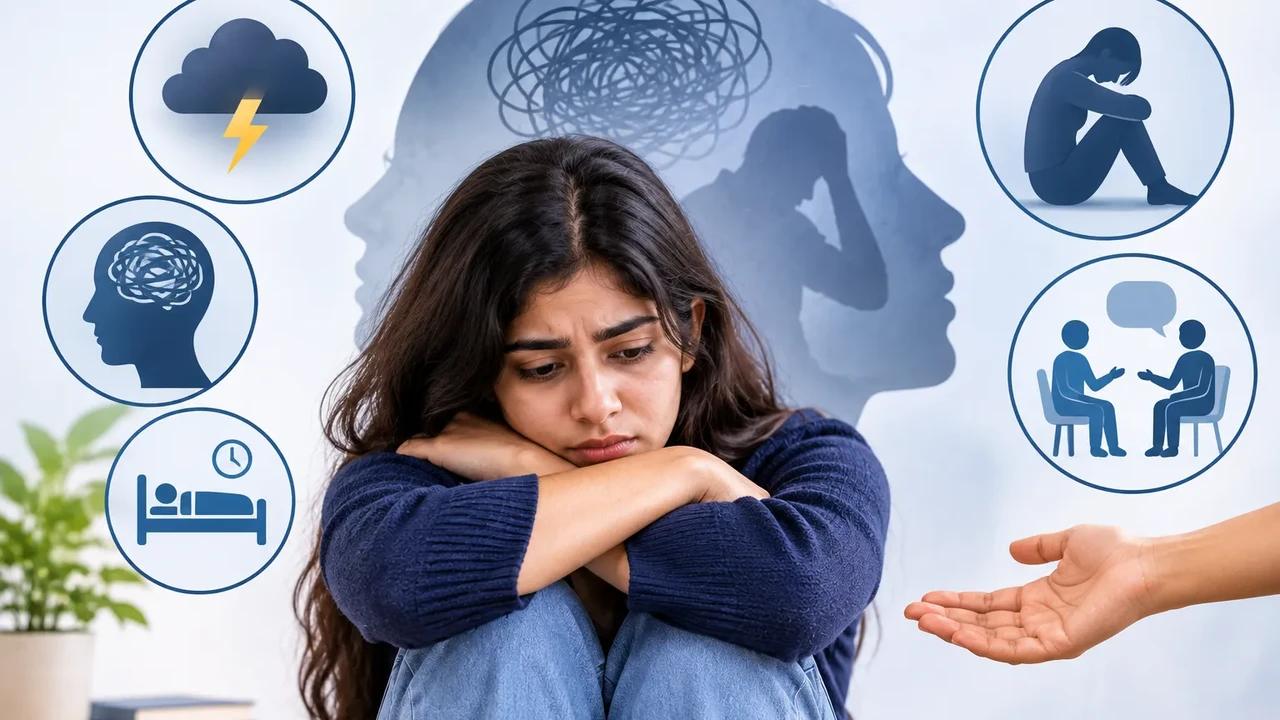
Quick answer: Post-traumatic stress disorder (PTSD) is a mental health condition that can develop after a frightening or shocking event, such as a road accident, assault, sudden death of a loved one, flood or earthquake. Its core symptoms are reliving the event (flashbacks, nightmares), avoiding reminders of it, and feeling constantly on guard or easily startled, for weeks or months after the danger has passed.
Strong reactions in the first few days or weeks after a trauma are normal and often fade on their own. It is when symptoms last more than about a month, or get worse and disturb sleep, work, studies or relationships, that a doctor or psychologist should check for PTSD. In India you can talk to a trained counsellor free, at any hour, on the Tele-MANAS helpline: 14416 or 1-800-891-4416.
How common is PTSD?
According to the World Health Organization, about 70% of people go through at least one potentially traumatic event in their life, but only around 3.9% of the world's population has had PTSD at some point. In other words, most people who face trauma recover without developing the condition. Whether someone does depends on the event, what happened afterwards and their own history.
Also read: Depression: Symptoms, Causes and Where to Get Help in India
PTSD symptoms
Doctors group the symptoms into a few clusters. A person does not need every symptom, and they can come and go.
1. Reliving the trauma
Flashbacks: feeling, for a few seconds or longer, as if the event is happening again right now.
Nightmares about the event or its feelings.
Intrusive memories that arrive without warning.
Strong body reactions to reminders: racing heart, sweating, shaking or nausea when a horn sounds, a smell returns or a date comes around.
2. Avoidance
Avoiding the place, road, people or activity linked to the trauma (for example, refusing to travel by bike after an accident).
Refusing to talk or think about what happened, or keeping very busy so it never comes up.
3. Feeling on edge (hyperarousal)
Being easily startled by sudden sounds.
Constantly scanning for danger, even at home.
Irritability, angry outbursts, poor concentration.
Trouble falling or staying asleep.
4. Changes in mood and thinking
Blaming yourself or others for the event ("I should have stopped it").
Feeling numb, detached from family and friends, or unable to feel happiness.
Losing interest in things you used to enjoy.
Gaps in memory about parts of the event.
The NHS also notes physical complaints such as repeated headaches, stomach problems or pain anywhere in the body that has no physical cause. Many people with PTSD also have depression or anxiety, and some start using alcohol or other substances to cope.
Symptoms in children
Children may show trauma differently: re-enacting the event in play, frightening dreams without clear content, bedwetting after they were dry, clinging to parents, or new stomach aches and headaches before school. Teenagers may look more like adults, with anger, risk-taking or withdrawal.
Normal reaction, acute stress or PTSD? A timeline
Most searches stop at a symptom list. The more useful question for a worried family is when a reaction stops being "normal". The two main manuals doctors use, the WHO's ICD-11 (in force since January 2022) and the American DSM-5-TR, draw the lines slightly differently:
Time after the event | What it usually is | What it means |
Hours to a few days | Acute stress reaction | Shock, crying, fear, poor sleep. ICD-11 treats this as an expected response, not a mental disorder. Rest, safety and support usually help. |
3 days to 1 month | Acute stress disorder (DSM-5-TR term) | Symptoms like PTSD that are strong enough to disrupt daily life. Worth seeing a professional, especially if severe. |
More than 1 month (DSM-5-TR), or "at least several weeks" (ICD-11) | PTSD | Reliving, avoidance and a sense of current threat that persist and cause real difficulty at home, work or study. |
Months or years later | Delayed-onset PTSD | Symptoms can first appear, or flare up, long after the event, sometimes set off by a new stress or an anniversary. |
Complex PTSD (CPTSD)
ICD-11 also recognises complex PTSD. It usually follows long-lasting or repeated trauma that was hard or impossible to escape, such as childhood abuse, prolonged domestic violence, trafficking or torture. Alongside the core PTSD symptoms, a person has lasting problems with:
controlling emotions (intense anger, or feeling shut down),
seeing themselves as worthless, ashamed or guilty, and
keeping close relationships.
DSM-5-TR does not list complex PTSD as a separate diagnosis, so you may hear doctors in India use either system. Only a qualified professional can make either diagnosis.
What causes PTSD?
PTSD is caused by exposure to an event involving actual or threatened death, serious injury or sexual violence. This can happen to you, you can witness it, or you can learn that it happened to someone close to you. Repeated exposure at work counts too, which is why police, firefighters, ambulance staff and doctors are at risk.
Common triggering events for Indians include:
Road and rail accidents, as a victim, survivor or witness.
Floods, cyclones, earthquakes, landslides and fires.
Physical or sexual assault, including within the family or marriage.
Domestic violence, dowry harassment and childhood abuse.
Sudden or violent death of a family member, or a traumatic childbirth or ICU stay.
Riots, terror attacks and armed conflict, including for soldiers and people in conflict-hit areas.
Why some people develop PTSD and others don't
Researchers have found several factors that raise the risk:
How severe, long or personal the trauma was, and whether the person was injured.
Earlier trauma, especially in childhood.
A past or family history of anxiety, depression or other mental health problems.
Little support after the event: being blamed, disbelieved or left alone. This is one of the strongest factors, and one families can change.
Extra stress afterwards, such as losing a job, a home or a breadwinner.
PTSD is not a sign of weakness, and it is not something a person can simply "get over" by trying harder.
Also read: Kidney Stones: Symptoms, Causes, Types and When to Seek Help
When to see a doctor
See a psychiatrist, clinical psychologist or your family doctor if:
symptoms have lasted more than about four weeks, or are getting worse;
sleep, work, studies or family life are seriously affected;
you are drinking more or using substances to cope; or
a child's behaviour has changed sharply after a frightening event.
PTSD is treatable, even years later. The WHO and the NHS recommend trauma-focused talking therapies, mainly trauma-focused cognitive behavioural therapy (CBT) and EMDR (eye movement desensitisation and reprocessing). A psychiatrist may also suggest medicine in some cases. The treatment plan is decided by the professional who assesses you.
Where to get help in India
Tele-MANAS (24×7, free, around 20 Indian languages): call 14416 or 1-800-891-4416. Counsellors can talk you through what you are feeling and refer you to services near you. Details are on the Tele-MANAS website of the Union Health Ministry.
Government hospitals: the psychiatry department of a medical college or district hospital, many of which run mental health services under the District Mental Health Programme.
Private care: a psychiatrist, or a clinical psychologist registered with the Rehabilitation Council of India (RCI).
The Mental Healthcare Act, 2017 gives every person in India the right to access mental health care from government-run or funded services.
If you or someone near you is in immediate danger or thinking of self-harm, call 112 or go to the nearest hospital emergency now.
How family and friends can help
Listen without pushing for details, and believe what the person tells you.
Don't say "forget it" or "be strong"; say "it makes sense you feel this way".
Help with practical things: meals, paperwork, travel to appointments.
Keep routines steady, especially for children.
Encourage professional help, and offer to go along.
Frequently asked questions
Can PTSD go away on its own?
Many people's early stress reactions settle within a few weeks without treatment. If symptoms last longer than about a month, they are less likely to fade by themselves, and trauma-focused therapy helps most people.
How long after a trauma can PTSD start?
Symptoms usually begin within the first month, but delayed-onset PTSD can appear months or even years later, often set off by a new stress or a reminder of the event.
What is the difference between PTSD and complex PTSD?
Complex PTSD, recognised in the WHO's ICD-11, usually follows long or repeated trauma. It includes the core PTSD symptoms plus lasting problems with emotions, self-worth and relationships.
Is there a free PTSD helpline in India?
Yes. Tele-MANAS, run by the Union Health Ministry, offers free 24×7 counselling on 14416 or 1-800-891-4416. In an emergency, call 112.
Filed under Health & Fitness


Comments