
Seven Wonders of the World: Names, Facts and the Ancient List Explained
The New Seven Wonders of the World, chosen in a 2007 public vote, explained simply: names, where they are, who built them, myths busted, and the Ancient Seven Wonders list, of which only the Great Pyramid survives.
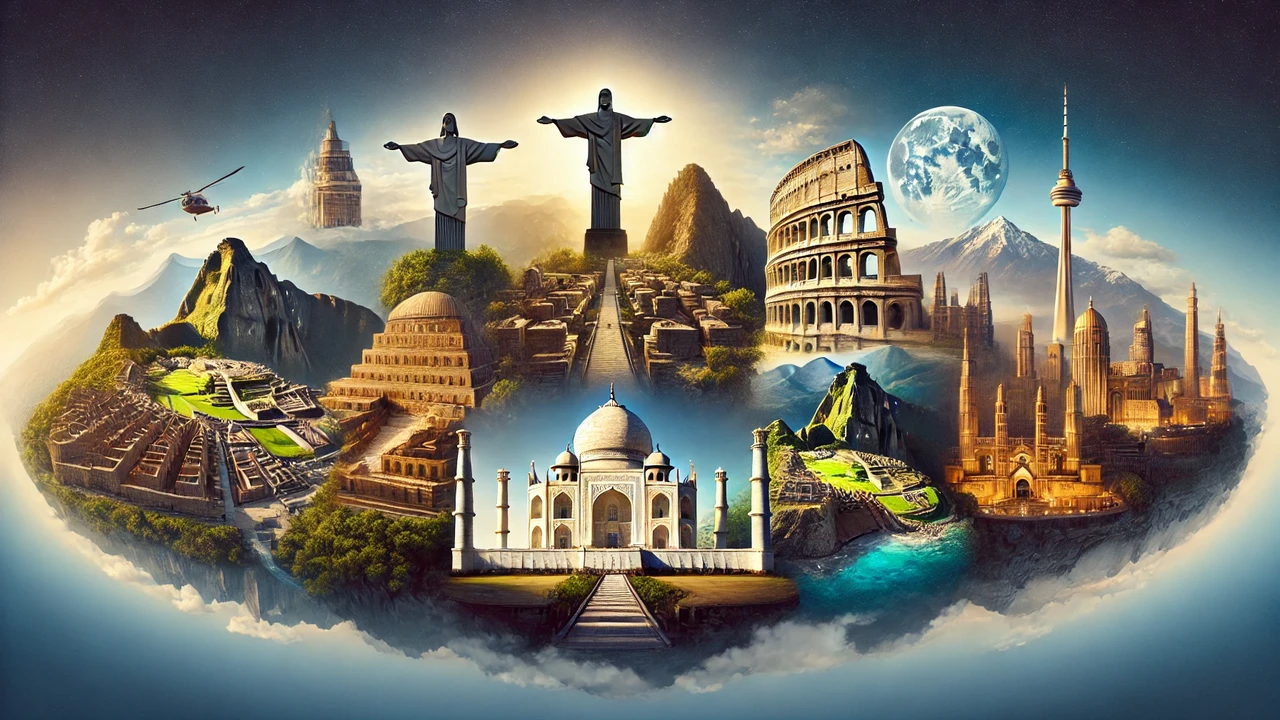
The Seven Wonders of the World most people mean today are the "New Seven Wonders", chosen in a worldwide public vote and announced in Lisbon on 7 July 2007. They are the Great Wall of China, Petra in Jordan, Christ the Redeemer in Brazil, Machu Picchu in Peru, Chichen Itza in Mexico, the Colosseum in Italy and India's own Taj Mahal.
Quick answer: the 7 wonders of the world names are Great Wall of China, Petra, Christ the Redeemer, Machu Picchu, Chichen Itza, the Roman Colosseum and the Taj Mahal. The older list, the Ancient Seven Wonders, was compiled by Greek writers more than 2,000 years ago, and only one of those, the Great Pyramid of Giza, still stands.
7 wonders of the world list at a glance
Wonder | Country | Built by / when | Why it is famous |
Great Wall of China | China | Many dynasties, from about the 7th century BC; most surviving parts are Ming (1368–1644) | The longest structure ever built |
Petra | Jordan | Nabataeans, roughly 2,000 years ago | A city carved into rose-red sandstone |
Christ the Redeemer | Brazil | Completed 1931 | Giant Art Deco statue above Rio de Janeiro |
Machu Picchu | Peru | Inca, 15th century | Mountain-top city in the Andes |
Chichen Itza | Mexico | Maya city, flourished about 600–1200 AD | The El Castillo step pyramid |
Colosseum | Italy | Romans, opened in 80 AD | Largest amphitheatre of the ancient world |
Taj Mahal | India | Mughal emperor Shah Jahan, 17th century | White marble mausoleum in Agra |
Also read: Are the Seven Wonders of the World Official? The Ancient List vs the 2007 New7Wonders
Who chose the New Seven Wonders?
The list was not made by UNESCO or any government. It came from a campaign run by the private, Switzerland-based New7Wonders Foundation, which shortlisted candidates and let the public vote online and by phone. The organisers said more than 100 million votes were cast, though one person could vote more than once, so it was a popularity contest rather than a scientific ranking.
Egypt objected to the Pyramids of Giza competing against newer monuments, so the Great Pyramid was given an honorary place outside the vote. If you want the full story of how "official" the list is, read our explainer on whether the seven wonders of the world are official.
The New Seven Wonders, one by one
1. The Great Wall of China
The Great Wall is not one wall but a network of walls, trenches and watchtowers built over many centuries to guard China's northern frontier. A survey completed by Chinese authorities in 2012 measured all its branches at about 21,196 km. That is long, but not long enough to "circle the Earth twice" as an old myth says (the Earth's circumference is about 40,000 km). Another myth to drop: you cannot see it with the naked eye from space. Sections near Beijing, such as Badaling and Mutianyu, are the easiest to visit.
2. Christ the Redeemer, Brazil
This statue of Jesus with open arms stands on Corcovado mountain above Rio de Janeiro. It is about 30 metres tall (roughly 98 feet), not counting its 8-metre pedestal, and was inaugurated in 1931. It is made of reinforced concrete covered in thousands of small soapstone tiles, and it is struck by lightning several times a year.
3. Machu Picchu, Peru
Machu Picchu was built in the 15th century, most likely as an estate for the Inca emperor Pachacuti, on a ridge about 2,400 metres above sea level. It was abandoned around the time of the Spanish conquest, and the Spanish never found it. Local farmers always knew it was there; the American explorer Hiram Bingham brought it to world attention in 1911. Much of the granite was quarried on the mountain itself, and the Inca fitted the blocks so tightly that no mortar was needed.
4. Chichen Itza, Mexico
Chichen Itza was one of the largest Maya cities on the Yucatán Peninsula. Its best-known building, El Castillo (the Temple of Kukulcán), has 91 steps on each of its four sides; add the top platform and you get 365, one for each day of the year. At the spring and autumn equinoxes, the late-afternoon sun throws a pattern of triangles down the staircase that looks like a serpent sliding down to the stone snake head at the bottom.
5. The Colosseum, Italy
The Colosseum in Rome opened in 80 AD under Emperor Titus. It is usually estimated to have held around 50,000 spectators, who came to watch gladiator fights, animal hunts and public shows. Earthquakes and centuries of stone robbing destroyed part of the outer wall, but it remains the largest amphitheatre ever built in the Roman world.
6. Taj Mahal, India
The Taj Mahal in Agra is the white marble tomb that Mughal emperor Shah Jahan built for his wife Mumtaz Mahal, who died in 1631. Work began around 1632; the mausoleum was finished in about a decade and the whole complex by around 1653. Historians commonly cite about 20,000 workers. The marble seems to change colour from pink at dawn to white at noon and gold in the evening. It became a UNESCO World Heritage Site in 1983. For more, see our facts about the Taj Mahal.
7. Petra, Jordan
Petra was the capital of the Nabataean kingdom, a trading people who grew rich on caravan routes. Its tombs and temples are cut straight into pink sandstone cliffs, which is why it is called the "Rose City". You reach it through the Siq, a narrow gorge, which opens onto Al-Khazneh (the Treasury). Film fans know that facade from Indiana Jones and the Last Crusade (1989).
The Ancient Seven Wonders of the World
The original list was put together by Greek travellers and writers, and it only covered the Mediterranean and Middle East, the world they knew.
Ancient wonder | Where | Status today |
Great Pyramid of Giza | Egypt | Still standing, the oldest of the seven |
Hanging Gardens of Babylon | Iraq | Lost; some historians doubt they existed |
Temple of Artemis at Ephesus | Turkey | Destroyed; only foundations remain |
Statue of Zeus at Olympia | Greece | Destroyed |
Mausoleum at Halicarnassus | Turkey | Destroyed by earthquakes |
Colossus of Rhodes | Greece | Toppled by an earthquake |
Lighthouse of Alexandria | Egypt | Destroyed by earthquakes |
The word "mausoleum" itself comes from the Mausoleum at Halicarnassus, the tomb of a ruler called Mausolus.
Also read: Hindu Calendar Months: Names, English Equivalents and Amanta vs Purnimanta Explained
Is there an Indian wonder in the list?
Yes. The Taj Mahal is the only Indian monument among the New Seven Wonders. India has many other UNESCO World Heritage Sites, from the Ajanta and Ellora caves to the forts of Rajasthan. If you love heritage travel, our list of lesser-known destinations in Rajasthan is a good place to start.
Why the seven wonders still matter
They tell human stories. Love and grief (Taj Mahal), empire (Colosseum), trade (Petra) and faith (Christ the Redeemer).
They show early engineering. Most were built without modern machines, using careful planning and huge workforces.
They need protection. Heavy tourism, pollution and weather damage all of them, which is why sites such as Machu Picchu and the Taj Mahal limit visitor numbers or timings. Always check each site's official website for current tickets and rules before you plan a trip.
FAQs
What are the 7 wonders of the world names?
The Great Wall of China, Petra, Christ the Redeemer, Machu Picchu, Chichen Itza, the Roman Colosseum and the Taj Mahal. They were announced on 7 July 2007 after a global public vote.
Which of the 7 wonders is in India?
The Taj Mahal in Agra, Uttar Pradesh. It is the only Indian site on the New Seven Wonders list.
Which ancient wonder still exists?
Only the Great Pyramid of Giza in Egypt. The other six ancient wonders were destroyed by earthquakes, fire or time, and the Hanging Gardens of Babylon may never have existed.
Is the seven wonders list official?
Not in any government or UNESCO sense. The New Seven Wonders were chosen in a vote run by the private New7Wonders Foundation, so the list is popular rather than official.
Can you see the Great Wall of China from space?
No, not with the naked eye from orbit. The wall is long but narrow, and it is roughly the same colour as the land around it.
Read next


Comments