
Urinary Tract Infection (UTI): Symptoms, Causes and When It's an Emergency
How to tell a simple bladder infection from a kidney infection, how UTIs show up differently in children, older people and diabetics, and why India's rising antibiotic resistance makes self-medication risky.
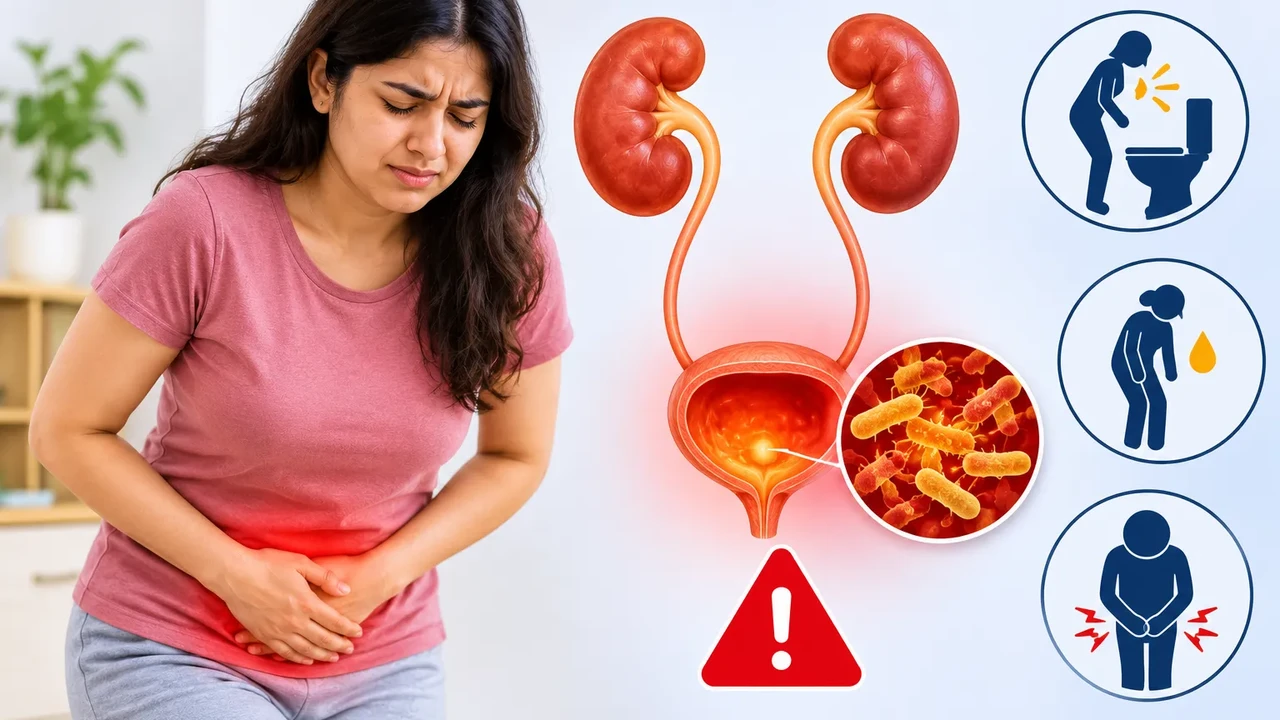
Quick answer: A urinary tract infection (UTI) is usually caused by bacteria from the bowel getting into the urethra and moving up to the bladder. The common symptoms are burning or pain while passing urine, needing to go often and urgently, cloudy or bad-smelling urine, and pain in the lower tummy.
Most bladder infections are mild and settle with the right treatment. But fever, pain in the back or side, vomiting or blood in the urine can mean the infection has reached the kidneys, and that needs a doctor the same day. Pregnant women, children, men, older people and people with diabetes should see a doctor for any suspected UTI.
What a UTI actually is
The urinary tract runs from the kidneys, through two tubes called ureters, to the bladder and out through the urethra. Infection can start anywhere along it, but most begin low down.
According to the NHS, UTIs are usually caused by bacteria from poo entering the urinary tract through the urethra. In India, the most common culprit is E. coli. The Indian Council of Medical Research (ICMR) found in its 2024 antimicrobial resistance surveillance report that E. coli made up about half (50.7%) of all bacteria grown from urine samples across its network of hospitals.
Also read: PTSD: Symptoms, Causes, Complex PTSD and Where to Get Help in India
Symptoms of a UTI
The NHS lists these as the main symptoms in adults:
Pain, burning or stinging when you pass urine
Needing to pass urine more often than usual, including at night
Needing to go suddenly or urgently
Cloudy urine, or blood in the urine
Pain in the lower tummy, or in the back just under the ribs
A high temperature, or feeling hot and shivery
Feeling tired or weak
Dark or smelly urine on its own, the NHS notes, may simply mean you have not been drinking enough, which is easy in an Indian summer.
Bladder infection or kidney infection? Know the difference
A bladder infection (cystitis) is uncomfortable but usually not dangerous. A kidney infection (pyelonephritis) is more serious. The NHS warns that an untreated kidney infection can lead to sepsis, a life-threatening reaction to infection.
Lower UTI (bladder, urethra) | Upper UTI (kidney) | Emergency | |
Typical signs | Burning urine, frequent and urgent need to go, lower tummy pain, cloudy urine | High fever, shivering, pain in the lower back or side, nausea or vomiting, a very low temperature (below 36°C) | Confusion, drowsiness, difficulty speaking |
What it means | Infection is low down in the tract | Infection has likely reached a kidney | Possible sepsis |
What to do | See a doctor, especially if it does not improve within 2 days | See a doctor the same day | Go to the nearest emergency department or call 108/112; do not drive yourself |
The NHS page on kidney infection also says to get urgent help if your temperature drops below 36°C, if you have been sick, or if you have not passed urine all day.
Symptoms can look different in some people
Children
The NHS says a urine infection in a child may show up as a high fever, being generally unwell, bedwetting or wetting themselves, or vomiting. Babies and young children may be irritable and not feed, eat or drink properly. Any child with a suspected UTI should be seen by a doctor.
Older people
In older or frail people, and those with dementia or a catheter, the NHS lists new confusion or agitation, worse incontinence than usual, and new shivering as possible signs, even without burning urine.
Men
UTIs are less common in men, but a man with UTI symptoms should always see a doctor. The NHS notes that an enlarged prostate can stop the bladder emptying fully, which raises the risk.
Pregnancy
The NHS advises pregnant women to get urgent medical advice for UTI symptoms, and to check with a doctor before taking cranberry products.
People with diabetes
India has a very large number of people living with diabetes, and they need to take UTIs more seriously. The US National Institute of Diabetes and Digestive and Kidney Diseases (NIDDK) explains that diabetes can damage the nerves of the bladder, so it may not empty fully. Urine that stays in the bladder too long can lead to infection, which can then spread to the kidneys. The NIDDK adds that managing your blood sugar helps prevent bladder infections. Our guide to diabetes diagnosis and treatment covers how blood sugar is checked and managed.
What causes UTIs and who is at risk
Women get UTIs far more often than men because the urethra is shorter, so bacteria have less distance to travel. According to the NHS, other things that raise the risk include:
Wiping from back to front after using the toilet
Not emptying the bladder fully, for example because of an enlarged prostate in men or constipation in children
Blockages in the urinary tract, such as kidney stones
Having a urinary catheter
A weakened immune system, for example from poorly controlled diabetes or chemotherapy
Menopause
Pregnancy
Using spermicide with contraception
Not drinking enough fluids
Why you should not self-treat with leftover antibiotics
Buying a strip of antibiotics from the chemist, or finishing an old prescription at home, at the first sign of burning is common in India. It is risky for two reasons.
First, the wrong antibiotic may simply not work. The ICMR's surveillance reports show E. coli in Indian hospitals becoming resistant to many commonly used antibiotics year after year. In the 2024 report, only about 1 in 4 E. coli from urine samples were still susceptible to cefotaxime (25.8%) or ciprofloxacin (22.4%), two widely used antibiotics. A urine test, and a urine culture where needed, helps the doctor choose a medicine that will actually work.
Second, every unnecessary course adds to the problem. The World Health Organization says the misuse and overuse of antimicrobials are driving the development and spread of drug-resistant infections. Never take antibiotics prescribed for someone else, or leftovers from an old course.
A doctor may also find that your symptoms come from something other than a UTI, which would need different care. And according to the NHS, antibiotics are not always needed for a UTI at all; sometimes a doctor will suggest waiting 48 hours to see if mild symptoms settle.
Also read: Depression: Symptoms, Causes and Where to Get Help in India
Simple habits that lower the risk
The NHS recommends:
Drink plenty of fluids, mainly water
Do not hold in urine for long, and take your time to empty the bladder fully
Wipe from front to back
Keep the genital area clean and dry, and avoid scented soaps there
Pass urine soon after sex
Wear cotton underwear and avoid tight underwear
Change nappies or incontinence pads promptly if they are soiled
If long commutes, busy shifts or a lack of clean toilets mean you often hold urine for hours or drink less to avoid the toilet, plan breaks and carry water where you can.
What about cranberry juice?
The NHS says there is some evidence that cranberry products may help prevent bladder infections in people who get them repeatedly, but no evidence that they ease symptoms or treat an infection that has already started. Pregnant women should check with a doctor first. They can be high in sugar, which matters with diabetes, and people taking warfarin should avoid them.
When to see a doctor
See a doctor promptly if:
You are pregnant, a man, 65 or older, use a urinary catheter, or have diabetes or a weak immune system
A child has symptoms
You have fever, shivering, back or side pain, vomiting or blood in the urine
Symptoms get worse quickly or do not improve within 48 hours
You keep getting UTIs; the NHS uses 2 in 6 months or 3 in a year as a sign to get checked
Frequently asked questions
Can a UTI go away on its own?
Sometimes mild symptoms do settle, which is why a doctor may suggest waiting a couple of days before antibiotics. You cannot judge this safely at home, so get checked if symptoms worsen, last beyond 48 hours, or come with fever or back pain.
Is a UTI contagious?
Cleveland Clinic says a bladder infection is not contagious and cannot be passed on through close contact or sex. Sex can, however, push your own bacteria towards the urethra, which is why passing urine afterwards is advised.
Can drinking more water cure a UTI?
Water helps flush the bladder and is a good preventive habit, but it does not reliably clear an established infection. If symptoms continue, a doctor needs to decide whether treatment is required.
Why do some women get UTIs again and again?
Repeated UTIs can be linked to things like menopause, diabetes, incomplete bladder emptying, kidney stones or some contraceptives. Frequent infections are a reason to see a doctor, who may test your urine and look for an underlying cause.
Filed under Health & Fitness



Comments