
What Is a Dictatorship and How Did Hitler Come to Power? A Dated Timeline
The types of dictatorship, a date-by-date table of the 18 months that turned Germany's Chancellor into Führer, the warning signs scholars watch for, and the safeguards India added to its Emergency rules in 1978.
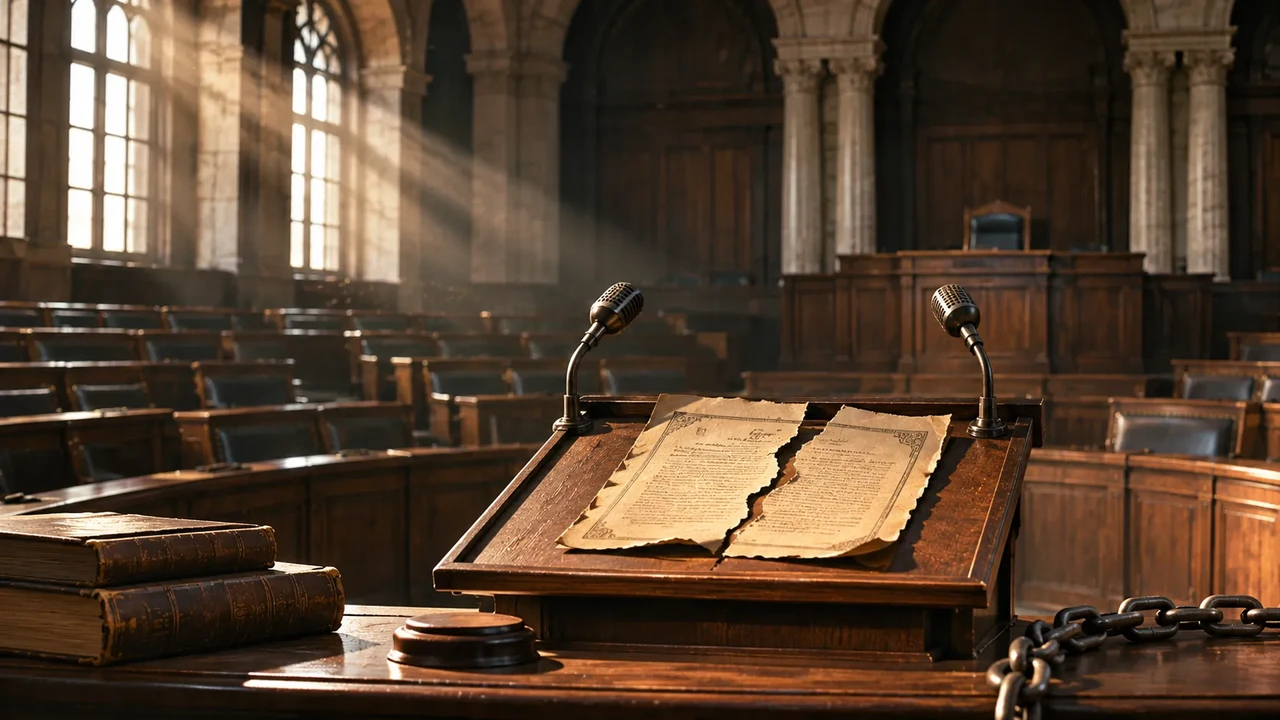
Quick answer: A dictatorship is a system in which one person or a small group holds power without real limits from a constitution, courts, a free press or fair elections. Adolf Hitler did not seize Germany in a coup. He was appointed Chancellor on 30 January 1933, and in the next 18 months he used emergency decrees, a parliamentary vote and a referendum to dismantle the Weimar Republic from the inside.
Much of that destruction was done through steps that looked legal on paper. The timeline below shows how fast it happened, and the last section explains the safeguards India's Constitution now has against misuse of emergency powers.
What is a dictatorship?
Encyclopaedia Britannica defines dictatorship as a form of government in which "one person or a small group possesses absolute power without effective constitutional limitations." The word comes from ancient Rome, where a dictator was a temporary official given extraordinary powers during a crisis, and was expected to hand them back afterwards.
In a democracy, power is borrowed: voters can remove the government, courts can strike down illegal actions and the press can investigate. In a dictatorship, those checks are abolished or kept only as decoration.
Types of dictatorship
Political scientists sort non-democratic regimes by who actually holds power. A widely used scheme, developed by the American political scientist Barbara Geddes, separates military, single-party and personalist regimes, with monarchies often added as a fourth group.
Type | Who holds power | How it usually works |
Military dictatorship | A group of officers (a junta) | Takes power in a coup; rules by decree, promising to "restore order" |
One-party state | A single ruling party | Other parties banned or made puppets; the party controls state and media |
Personalist dictatorship | One leader and an inner circle | Institutions bend to the ruler; loyalty to the person matters more than rules |
Absolute monarchy | A king or queen | Power is inherited; no elected body can overrule the monarch |
Competitive authoritarianism | An elected government that tilts the field | Elections happen, but courts, media and opponents are pressured so results are hard to change |
The last term, used by scholars Steven Levitsky and Lucan Way, describes systems that keep democracy's outward form while emptying its substance. Real regimes often mix types: Nazi Germany was both a one-party state and a personalist dictatorship.
For most of history, much of the world was ruled by monarchs; even the Arthashastra, the ancient Indian treatise on statecraft traditionally attributed to Chanakya, was written as advice for kings.
Also read: Partition of India and Pakistan (1947): Causes, Timeline, Radcliffe Line and Impact
How did Hitler come to power?
The Weimar Republic in crisis
After defeat in the First World War, Germany became a democratic republic under the Weimar Constitution of 1919. Its Article 48 let the President issue emergency decrees. From July 1930 Chancellor Heinrich Brüning governed by these decrees because the Reichstag (parliament) was deadlocked, getting Germans used to rule without parliament.
Then came the Great Depression: by the winter of 1932 about six million Germans were out of work, according to Britannica.
The 1932 elections
The US Holocaust Memorial Museum (USHMM) notes that in the July 1932 Reichstag election, Hitler's Nazi Party won 37% of the vote, more than any other party (230 seats, according to Britannica). In November 1932 its share fell to 33%, but it was still the largest party. It never won a majority in a free election.
Appointed, not elected
President Paul von Hindenburg at first refused to make Hitler Chancellor, then gave in to a deal by conservative politicians who believed they could control him, since Nazi ministers would be heavily outnumbered in the cabinet. On 30 January 1933, Hindenburg appointed Hitler. The plan to "tame" him failed within weeks.
From Chancellor to Führer: an 18-month timeline
Date | What happened | How it was made to look legal |
30 Jan 1933 | Hitler appointed Chancellor | A normal constitutional appointment by the President |
27 Feb 1933 | The Reichstag building burns | The government falsely presented the fire as a communist plot (USHMM) |
28 Feb 1933 | Reichstag Fire Decree | A presidential emergency decree suspending free speech, press freedom and assembly, and allowing detention without trial. It stayed in force until 1945 |
5 Mar 1933 | Last multi-party election | Held under the decree, amid arrests; the Nazi Party won 43.9% (USHMM), still short of a majority |
9–11 Mar 1933 | State governments overthrown | Reich commissioners installed under the fire decree |
23 Mar 1933 | Enabling Act passed, 444 votes to 94 | A two-thirds vote of parliament, but taken with armed SA men inside the chamber and many opposition deputies arrested or in hiding |
May 1933 | Independent trade unions abolished | Replaced by a single state-controlled labour body, the German Labour Front |
14 Jul 1933 | Law against the founding of new parties | The Nazi Party became the only legal party |
Sept–Oct 1933 | Reich Culture Chamber; Editors' Law | Writers, artists and journalists needed state-approved membership to work; non-"Aryans" barred from journalism |
30 Jun–2 Jul 1934 | Night of the Long Knives | Rivals and critics murdered; a cabinet law of 3 July declared the killings legal "emergency" action (USHMM) |
2 Aug 1934 | Hindenburg dies | Offices of President and Chancellor merged; military leaders swear an oath to Hitler personally |
19 Aug 1934 | Referendum | Approved with about 88% of votes cast (Britannica). Hitler is now "Führer and Reich Chancellor" |
Sources: USHMM 1933: Key Dates, The Reichstag Fire, Röhm Purge and Gleichschaltung entries; German Bundestag; Britannica.
The Enabling Act: democracy voting itself out
The single most important step was the Enabling Act of 23 March 1933. The German Bundestag's own history page explains that it let the government make laws without parliament, without the President's signature, and even laws that departed from the constitution.
Because it changed the constitution, it needed a two-thirds majority. The Bundestag records that the 81 communist seats had been cancelled under the fire decree, 26 deputies of the main remaining opposition party were in custody or had fled, and the rules were changed so that unexcused absentees counted as present. Only one party's 94 deputies voted no. The act was meant to last four years; it was renewed in 1937, 1939 and 1943, and was repealed by the Allies only in 1945.
Gleichschaltung: bringing everything into line
The Germans called the next stage Gleichschaltung, "coordination": in the USHMM's words, the effort to bring all political, social and cultural life under Nazi control. Unions, state governments, the civil service, the press and radio were taken over or shut down one by one, while a propaganda ministry under Joseph Goebbels made sure people heard one message. The USHMM's 1933 timeline has the full record.
Warning signs political scientists describe
In their 2018 book How Democracies Die, Harvard political scientists Steven Levitsky and Daniel Ziblatt list four key indicators of authoritarian behaviour in a politician:
Rejecting, in words or action, the democratic rules of the game.
Denying the legitimacy of political opponents.
Tolerating or encouraging violence.
Being willing to curtail the civil liberties of opponents, including the media.
These are general tools for studying any country and era, not labels for particular people. In Germany, none of the steps above was hidden, and many were justified as temporary emergency measures.
Also read: Did Nobara Really Come Back in Jujutsu Kaisen? How She Survived, Explained
What safeguards does India's Constitution have?
India's Constitution, which came into force on 26 January 1950 (the reason we celebrate Republic Day), allows a national Emergency under Article 352. After the 1975–77 Emergency, which had been proclaimed on the ground of "internal disturbance", Parliament passed the Constitution (Forty-fourth Amendment) Act, 1978. Its Statement of Objects and Reasons says the aim was to guard against rights being "taken away by a transient majority". The main changes:
Safeguard | What the 44th Amendment requires |
Narrower grounds | "Internal disturbance" replaced by "armed rebellion"; the other grounds are war and external aggression |
Cabinet in writing | The President can proclaim an Emergency only when the Union Cabinet's decision is communicated to him in writing |
Quick approval | The proclamation lapses after one month unless both Houses of Parliament approve it |
Special majority | Approval needs a majority of each House's total membership and two-thirds of members present and voting |
Regular renewal | It lapses every six months unless approved again |
Lok Sabha can end it | The President must revoke it if the Lok Sabha passes a disapproval resolution; one-tenth of its members can force a special sitting within 14 days |
Life and liberty protected | Articles 20 and 21 (protection in conviction for offences; life and personal liberty) cannot be suspended |
Article 19 limited | The automatic suspension of Article 19 freedoms applies only in an Emergency due to war or external aggression, not armed rebellion |
Compare that with Weimar Germany, where a single presidential decree suspended basic rights for 12 years without parliament ever approving it.
Ambedkar's warning about hero-worship
Rules alone cannot protect a democracy. In his closing speech to the Constituent Assembly on 25 November 1949, as recorded in the official Constituent Assembly Debates published by Parliament, Dr B.R. Ambedkar quoted John Stuart Mill's caution not "to lay their liberties at the feet of even a great man, or to trust him with powers which enable him to subvert their institutions." He went on:
"Bhakti in religion may be a road to the salvation of the soul. But in politics, Bhakti or hero-worship is a sure road to degradation and to eventual dictatorship."
Frequently asked questions
Was Hitler elected as dictator?
No. His party won the most votes in 1932 but never a majority in a free election. He was appointed Chancellor by President Hindenburg in January 1933 and then used decrees, the Enabling Act and a 1934 referendum to remove all limits on his power.
What was the Enabling Act of 1933?
It was a law passed by the Reichstag on 23 March 1933, by 444 votes to 94, that let Hitler's government make laws, including ones that broke the constitution, without parliament or the President. It effectively ended parliamentary democracy in Germany.
What is the difference between a dictatorship and a democracy?
In a democracy, power is limited by a constitution, independent courts, a free press and regular, fair elections that can remove the government. In a dictatorship, those limits are absent or exist only on paper.
Can an Emergency in India suspend the right to life?
No. Since the 44th Amendment of 1978, Articles 20 and 21 cannot be suspended even during a national Emergency, so the right to life and personal liberty stays enforceable in court.
Filed under History



Comments