
Migraine: Symptoms, Causes, Triggers and When a Headache Is an Emergency
The doctor's checklist for migraine, its four phases, a side-by-side table against tension, cluster and sinus headaches, why too many painkillers backfire, and the red-flag signs that need hospital care.
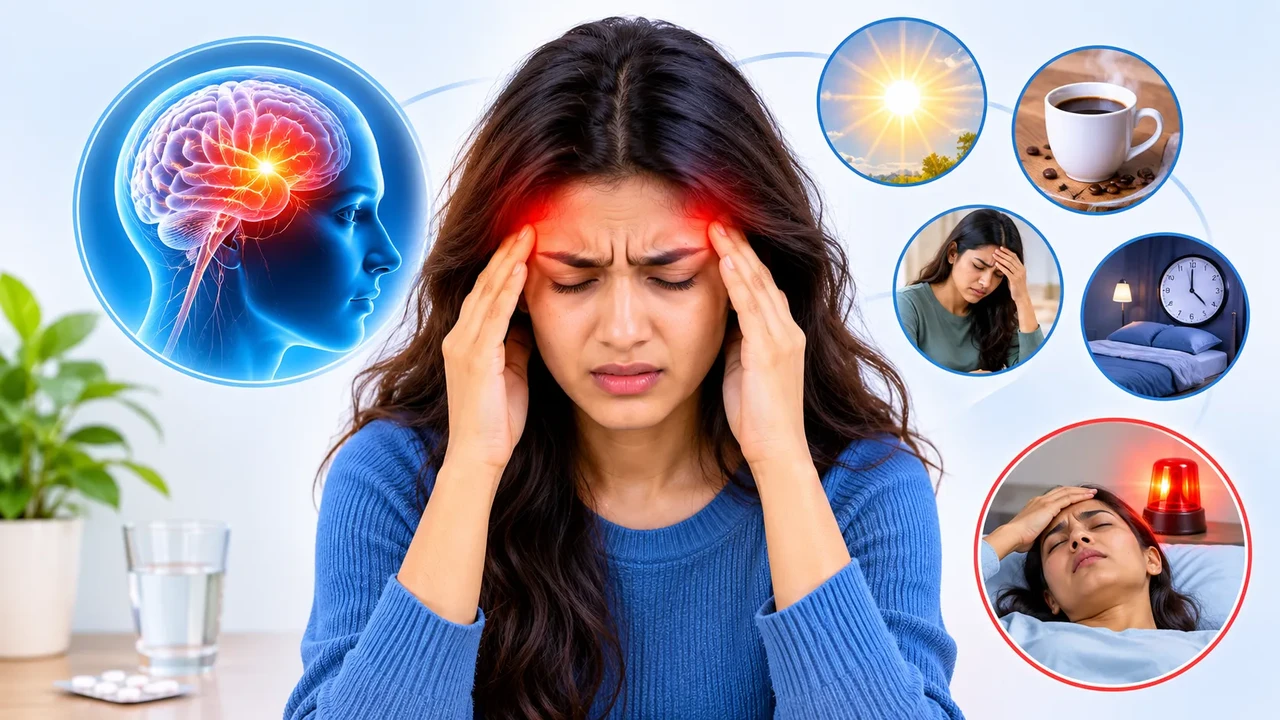
Quick answer: A migraine is a recurring headache disorder, not just a bad headache. According to the World Health Organization, attacks typically last 4 to 72 hours and come with nausea or vomiting and sensitivity to light and sound; some people get warning symptoms called an aura first. The exact cause is not known, but it runs in families, is more common in women (about three times, according to Mayo Clinic), and attacks are often set off by triggers such as stress, missed meals, poor sleep or periods.
Most migraines are painful but not dangerous. A few headache patterns are emergencies, though: a sudden "worst ever" headache, a headache with weakness, confusion or slurred speech, or one with fever and a stiff neck needs a hospital the same day. The full list is further down.
How common migraine is in India
Migraine is far more common than most people think. A door-to-door study of 2,329 adults in and around Bengaluru, led by researchers from NIMHANS and published in The Journal of Headache and Pain (2015), found that 25.2% had migraine in the previous year, and it was clearly more common in women than in men (the odds were about twice as high). The Global Burden of Disease estimates for India put the number at about 22 crore people with migraine in 2021.
The WHO ranks migraine as the third-biggest cause of ill health and disability among neurological conditions worldwide, after stroke and neonatal encephalopathy. In plain terms: it costs people workdays, school days and family time, even though it rarely shows up on a scan.
Also read: Urinary Tract Infection (UTI): Symptoms, Causes and When It's an Emergency
Is it a migraine? The doctor's checklist
Doctors diagnose migraine from your history, using the International Classification of Headache Disorders (ICHD-3). There is no blood test for it. For migraine without aura, the criteria are:
At least five attacks like this.
Each lasts 4 to 72 hours if untreated (2 to 72 hours in children and teenagers).
The headache has at least two of these: one-sided, throbbing or pulsing, moderate or severe, and made worse by routine activity such as walking or climbing stairs (or makes you avoid it).
During the headache you have at least one of: nausea and/or vomiting, or discomfort with both light and sound.
No other condition explains it better.
This checklist is useful before a doctor's visit: if your headaches tick these boxes, note them down. It is not a self-diagnosis tool. Only a doctor can rule out other causes.
The four phases of a migraine attack
Not everyone goes through all four, and they can vary from one attack to the next. Mayo Clinic describes them like this:
Phase | When | What people notice |
Prodrome | 1–2 days before | Mood changes, food cravings, a stiff neck, frequent yawning, constipation, passing urine more often |
Aura (only some people) | Builds over minutes, lasts up to 60 minutes | Flashing lights, zigzag lines or blind spots; pins and needles; trouble speaking |
Attack | 4–72 hours untreated | Throbbing pain, often on one side; nausea or vomiting; sensitivity to light, sound and sometimes smells |
Postdrome | Up to about a day | Drained, washed out or confused |
The NHS adds one important rule: aura symptoms should not last longer than an hour. An aura lasting more than an hour needs urgent medical advice; sudden weakness on one side, or slurred speech, is an emergency (call 112 or 108), because it can be a stroke.
Migraine vs other common headaches
Many Indians call every bad headache "migraine", and many real migraines get written off as "gas" or "sinus". The differences, as Cleveland Clinic describes them:
Migraine | Tension-type headache | Cluster headache | Sinus headache | |
Where | Often one side | Both sides, like a tight band | Behind one eye | Forehead, cheeks, bridge of the nose |
Feels like | Throbbing, moderate to severe | Pressing, mild to moderate, not throbbing | Burning or piercing, extremely severe | Dull ache with pressure |
Lasts | 4 hours to 3 days | 30 minutes to a week | 15 minutes to 3 hours, up to 8 a day, for weeks or months | While the sinus infection lasts |
Other signs | Nausea, light and sound sensitivity, worse with activity | Usually not worse with activity | Watery or droopy eye, runny nose, restlessness | Blocked nose, thick discoloured mucus, sometimes fever |
A "sinus headache" with no blocked nose or fever, that keeps coming back, is often migraine. That matters, because sinus medicines and antibiotics will not help it.
What causes migraine
The NHS says the cause is not known, but migraine happens when there are changes in the nerves and blood vessels of the brain. Mayo Clinic adds that genes play a part, and that the trigeminal nerve (a major pain pathway in the face and head) and brain chemicals such as serotonin and CGRP are involved. You are more likely to have migraine if a close relative does.
Common triggers
A trigger does not cause migraine; it can set off an attack in someone who already has it. Triggers differ from person to person, and the evidence for some of them is mixed. The ones the NHS and Mayo Clinic list include (between them):
Stress, anxiety and tiredness
Too little or too much sleep, or a changed routine
Skipping meals (a common one during fasts and long commutes)
Too much caffeine; alcohol, especially wine
Bright or flickering light, loud noise, strong smells such as perfume or paint
Weather changes
Hormonal changes, including periods and some hormonal medicines
Very hard physical exertion
A migraine diary is the most practical way to find yours. For each attack, note the date, time, what you ate and drank, how you slept, your period dates if relevant, and what medicine you took. After two or three months, patterns often show up, and the diary is exactly what a neurologist will ask to see.
Migraine and periods
Attacks that come just before or during a period are called menstrual migraine. The American Migraine Foundation links them to the drop in oestrogen at that time, and says that for nearly two in three women with migraine, attacks coincide with their period. Migraine often improves after menopause and sometimes during pregnancy, according to the NHS.
The painkiller trap: medication-overuse headache
This is one of the most useful things to know about migraine in India, where strong painkillers are easy to buy over the counter. Taking painkillers too often can cause more headaches. Doctors call this medication-overuse headache: headaches on 15 or more days a month in someone who already has a headache disorder and has been overusing headache medicines for more than three months.
The NHS advises not taking painkillers for headaches on more than two days a week. The WHO notes that medication-overuse headache is the most common headache caused by something else, affecting up to 5% of some populations. If you find yourself reaching for tablets most days, see a doctor rather than switching brands.
Also read: Panic Attacks: Symptoms, Causes, Panic vs Heart Attack and What to Do
When a headache is an emergency
Go to a hospital emergency department straight away (call 112 or 108 for an ambulance, and do not drive yourself) if a headache comes with any of these, based on NHS and Mayo Clinic guidance:
It is sudden and extremely painful, reaching full strength within seconds or a minute (a "thunderclap" headache)
Weakness or numbness on one side of the face or body, slurred speech or trouble understanding
Confusion, drowsiness, a seizure or fainting
Loss of vision, or double or blurred vision
Fever with a stiff neck or a rash
It started after a head injury
See a doctor soon (not an emergency, but don't wait weeks) if:
An attack lasts longer than 72 hours, or an aura lasts longer than an hour
You are pregnant or have just had a baby and get a severe headache
Your headaches are getting worse, more frequent (more than once a week) or feel different from usual
A new kind of headache starts after age 50
A headache gets worse when you cough, strain or bend
How migraine is treated
Treatment is planned with a doctor; a general physician can start, and a neurologist sees harder cases. In broad terms, the NHS describes two kinds:
Treatment for an attack: common painkillers taken early, prescription medicines called triptans (and newer ones called gepants), and anti-sickness medicines.
Prevention, for people with frequent or disabling attacks: daily medicines from several groups, chosen by the doctor to suit your other health conditions, plus approaches such as relaxation training and CBT.
Lying down in a dark, quiet room helps many people during an attack. Regular sleep, regular meals, enough water and regular exercise reduce attacks for some. If stress and worry are big triggers for you, our guide to anxiety symptoms and causes may help, and if you are wondering about your tea and coffee habit, see is it bad to drink coffee every day?.
This article is general information, not medical advice. Do not start, stop or change any medicine without speaking to your doctor.
Frequently asked questions
Can a migraine be cured permanently?
There is no permanent cure, but migraine can usually be controlled well. Treatment, trigger management and, where needed, preventive medicine can make attacks much less frequent and less severe, and many people find migraine eases with age or after menopause.
Do I need an MRI or CT scan for migraine?
Usually not. Migraine is diagnosed from your symptoms and an examination, and scans are normal in migraine. A doctor will order a scan if there are warning signs, such as a sudden severe headache, nerve symptoms or a changed pattern.
Is migraine hereditary?
It often runs in families. According to the NHS, you are more likely to get migraine if a close relative has it, though not everyone with a family history develops it.
Which doctor should I see for migraine in India?
Start with a general physician or family doctor. If attacks are frequent, severe, not responding to treatment or have unusual features, they may refer you to a neurologist. Take your headache diary along.
Filed under Health & Fitness



Comments